We recently attended SASANAC 2026 in Washington D.C… What is SASANAC you ask? Great question! I would love to tell you.
SASA, the Student Association for STEM Advocacy, was founded in 2020 to EXPAND access to STEM opportunities. SASA represents robotics students and teams from the largest extracurricular robotics programs, including FIRST and the REC Foundation, who have more than a million student participants worldwide each year.
NAC is the National Advocacy Conference, where every June students from across the country gather in Washington DC for a day and a half of training. We learn how the government works from people who work on Capitol Hill and the White House. We learn how to facilitate and control a meeting with our Representatives, and in our down times we have a little fun.
This year we went into our meetings with three “asks”. The first is the continued or increased funding for ESSA Title IV part A and B. This is one “ask” that is carried over year to year. In 2014 at the first NAC, we were lobbying for congress to pass this legislation under the Obama administration. We were successful! It was passed and signed into law in 2015. Since then, we have continually lobbied for increased funding for both parts. It is especially important now as the current administration has written their budget to defund both parts A and B to zero, so it is up to us to let congress know how important this funding is for STEM education in the United States.
So, what exactly is ESSA Title IV part A and B? This is the description published by SASA and provided to us at the conference. The wording has not changed since the law was passed in 2015. Every public school is provided with funds, distributed by the state, and the amount is based on how many Title I students are in the school district. If you are in New York and are curious how much funding your school receives from this legislation, you can find that out here: 2025-26 Final Allocations for Title IV, Part A | New York State Education Department
- ESSA Title IV-A is a flexible block grant program called Student Support and Academic Enrichment (SSAE) grants, which was authorized at $1.6 billion when the law passed. Title IV Part A authorizes activities in three broad areas:
- Well-rounded education, including programs in STEM including but not limited to extracurricular robotics.
- Safe and healthy students/schools.
- Technology (professional development, blended learning, and devices).
- School districts (LEA’s) can use Title IV-A grants to provide students with a well-rounded education and improve instruction and student engagement in STEM by:
- Increasing access to STEM;
- Supporting the participation of students in STEM nonprofit competitions (such as robotics, science research, invention, math, computer science, and technology competitions);
- Providing hands-on learning opportunities in STEM;
- Integrating other academic subjects, including the arts, into STEM subject programs;
- Creating or enhancing STEM specialty schools;
- Integrating classroom based and afterschool and informal STEM instruction.
- Title IV Part A, student support and academic enrichment grants, was funded at $1.38B in both FY25 & FY26.
- Title IV Part B’s 21st Century Community Learning Centers (21st CCLC) has been around for over 25 years. These can provide:
- Hands-on, academically enriching learning experiences
- Programs and activities focusing on subjects like STEM (and also physical fitness, wellness, drug and violence prevention, nutrition and health education, service learning, youth development, and arts and music)
- In-demand industry sectors or occupations to reinforce and complement the academic program of students (including financial literacy, career readiness, internships, and apprenticeships)
- Parental and Family engagement in their children’s education
- 21st CCLC increases engagement in school and reduces chronic absenteeism.
- Title IV, Part B was funded at $1.329B in FY25 & FY26.
Our second “ask” pertains to the NDAA or the National Defense Authorization Act. Our government is the highest employer of STEM workers in the U.S., and we are woefully short on STEM workers in the U.S… Because of this, we would like to involve the DOD (Department of Defense) in the training of our future STEM workforce.
Under this, we have two asks The first involves wording within the House version of this Bill. Part of the language is “Leveraging Regional STEM Ecosystems” and we are asking our House members to preserve this language in the bill. Regional STEM ecosystems already exist in our schools and community, and we feel rather than reinvent the wheel, we should tap into what is already there. This ask changes on the Senate side to “would you be willing to support the addition of identical language into the Senate version of this bill”. Either way this seems to be a very easy ask.
Our second major ask under the NDAA is finding someone to champion an amendment to the bill that would require defense contractors to take ¼ of 1% of their defense contract and funnel it to local STEM education programs in their immediate area. This would apply only to contracts over $10 M in size. For reference, in FY 25, the DoD awarded $508 billion in contract awards. That could have directed $1.27 billion to ensure a future pipeline of reliable STEM workers.
Our third ask is, in my opinion, even more important than our previous two asks, and it pertains to the Office of Management and Budget (OMB) Guidance. The proposed OMB rule, “Regulation for Federal Financial Assistance,” would rewrite the government-wide rules for how federal grants are awarded and managed, and it raises real concerns about who controls federal education dollars. The rule would insert political-appointee review into grant decisions before awards are made and would weigh the administration’s own priorities in ways that may not match the purposes Congress set when it authorized and appropriated these programs. It also adds new limits on using federal funds where a disparate-impact concern is raised. This could discourage the very investments that help schools – specifically those who serve underserved students – close longstanding opportunity gaps. For the programs our students depend on, this could shift control [AH1] over money Congress has already appropriated away from Congress and toward the discretion of the executive branch.
Our asks for our Representatives and our Senators are:
(1) Submit a comment to the docket (OMB-2026-0034) opposing the provisions that politicize grant decisions and threaten funding for underserved students or sign on to a member comment letter. Would you submit a comment opposing those provisions and/or sign on to a member comment letter?
(2) Support appropriations language in the FY27 Labor-HHS-Education bill blocking implementation of the rule, the same tool Congress has already used to rein in OMB on grant policy. Would you consider introducing/supporting such language?
(3) If the rule is finalized, commit to supporting a Congressional Review Act resolution of disapproval to preserve Congress’s power of the purse. Can we count on you to weigh in during the comment period and to help protect the federal grants that underserved students rely on most?
The proposed rule would 1, take the power of the purse away from congress where it belongs and 2, place the power squarely in the hands of whomever is in power, they could become purely political where currently the grants are reviewed by a group of their peers.
If you wish to have your opinion voiced, you can submit a public comment here Regulations.gov The comment period closes on July 13th.
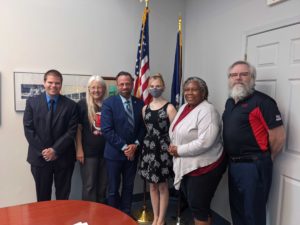
In conclusion we would like to thank all the offices that met with us on this trip, While all of our meetings were with staff members they are still very productive.
Congressman Joseph Morelle 25th district NY
Congresswoman Claudia Tenney 24th district NY
Congressman Jerry Nadler 12th district NY
Senator Chuck Schumer NY
Senator Kristin Gillibrand NY
Congresswoman Grace Meng 6th district NY
[AH1]This proposed rule could take Congress’ power over money away from the legislative branch and could shift the power to the political discretion of the executive branch.